
How many views should become enquiries?
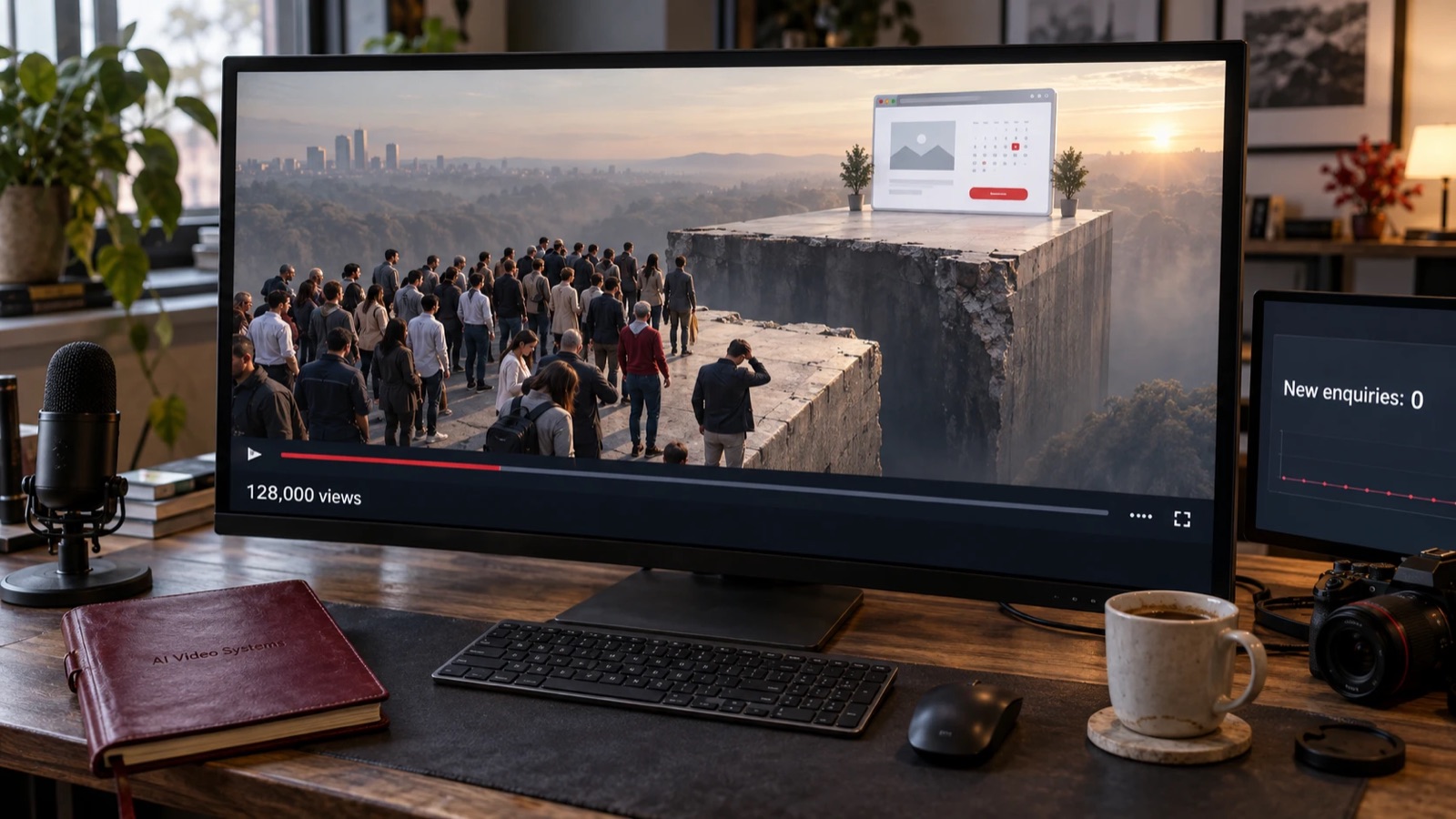
Far fewer than you'd expect. An AI-led campaign for Ironclad Finance produced more than 5 million views and 74 inbound enquiries in seven weeks. That's roughly one enquiry for every 67,000 views, or more, because the views were over 5 million. By anyone's standards that campaign worked. It also shows why a conversion rate on views is the wrong thing to chase.
The ratio of views to enquiries is small by nature, because most people who see a video are nowhere near buying. What you can control is who is in the views, and what happens to the few who raise a hand. I used to set minimum view targets in my own content plans. I now treat them as almost meaningless, because a number that measures distribution tells you nothing about whether anyone who could buy from you was watching.
What is the Attention Leak?
The Attention Leak is the gap between the attention you earned or paid for and the attention that ended up in front of someone who could buy, and then reached you. It's the part of the Video-to-Revenue Chain between the first view and the first enquiry, and it's where most of the loss sits. The same video can leak in five different places, and each place has a different fix, which is why "make better videos" is such a poor answer.
| # | Where the view stops | The five-minute test | What failing looks like |
|---|---|---|---|
| 1 | The wrong person watched | Compare your audience report with your last 10 customers | Most views come from people or places you can't serve |
| 2 | There was no next step | Find the sentence at the end of your last 5 videos that says what to do | You can't, or it says "follow for more" |
| 3 | Nobody can bring the watcher back | Check your ad account for an audience of video viewers and for any ad aimed at it | No audience, or an audience with no ad |
| 4 | The reply came too late | Pull the minutes from enquiry to first human reply for the last 20 | The median is hours, not minutes |
| 5 | Nothing came back to the content | Ask: which video produced your last customer? | Nobody can answer |
Leak 1: is the wrong person watching?
If most of your views come from people who can't buy from you, the video is working and the audience is wrong. This is the leak that makes a good-looking dashboard least useful.
The test. Open the audience report for your last five videos and put it beside your last ten customers: where they live, what they do, how they found you. A kitchen fitter or remodeller whose views come largely from outside the area they cover has a reach problem, not a conversion problem. A mortgage broker whose views skew to people with no property to buy has the same one.
The fix. Name the buyer in the first seconds so the wrong viewer scrolls on, and narrow who the platform shows it to. A view from the right prospect is a buying signal, and a million from the wrong ones is a bill. The hook decides which views you get, and on a paid campaign, so does the targeting. Both are cheaper to correct than a new shoot.
Leak 2: is there a next step at the end?
If a viewer can't tell what to do next, the most interested ones leave anyway. This is the cheapest leak to fix and the one most often found.
The test. Watch your last five videos with the sound on. Write down the exact sentence that tells the viewer what to do next, and where it takes them. If you can't find one, or it's "follow for more", that's the finding.
The fix. One next step, matched to how warm the viewer is. To a cold viewer: watch the next video, see the proof. To a warm one: book the call. Asking a stranger 20 seconds in to book a consultation is a leak of its own. So is no ask at all, which is how most brand video ends.
Leak 3: can you bring the watchers back?
Most people won't act on the first video. If you can't reach them again, you've paid for attention you can't use twice.
The test. Open your ad account. Is there an audience of people who watched your videos, or visited your page? Is any ad aimed at it? On YouTube, the audience retention report shows the share of viewers still watching after the first 30 seconds, which tells you whether the video even held them long enough to be worth coming back to. In Meta's Ads Manager you can build a custom audience from people who watched a set share of a video; check the options and the look-back windows in your own account, as they change.
The fix. Build the viewer audience, and run a second, different ad at it. A second touch shouldn't repeat the first. It should carry proof: a client story, a result with its limits, the answer to the objection that stops people. That second ad is where a view starts to become a sale.
Leak 4: how fast do you reply?
A viewer who enquires is at peak interest for a short window. The video did its job; the reply decides whether it counted.
The test. Pull the timestamps for your last 20 enquiries and work out the minutes between the enquiry and the first human reply. Don't count the automatic confirmation email.
The evidence. The 2021 InsideSales Lead Response Management study of 5.7 million leads found conversion was 8 times higher when the first call came within five minutes. Under 1% of first attempts happen that fast. If your median is hours, this is almost certainly your biggest leak, and no creative work will compensate. The setup is in the five-minute rule, and why Facebook ad leads go cold covers it from the ad side.
The fix. One named person owns the first reply, an automated first message goes out in seconds, and a human follows inside minutes in working hours.
Leak 5: does anything come back to the video?
If outcomes never reach the people making the next video, production runs blind. You'll keep making more of what got views, not what got customers.
The test. Ask: which video produced your last customer? Then ask your last five customers what made them get in touch. If nobody can answer, links between video and sale are missing.
The fix. Tag every lead with where it came from, ask "what made you get in touch today?" on the first call and write the answer down, and spend twenty minutes a month on one list: leads by source, calls booked, customers won. That list tells you which idea to make next. It's also the difference between a content calendar and a system, which is why marketing and sales have to read one scoreboard.
Which leak do I fix first?
Run all five tests in one sitting; it takes about twenty-five minutes. Then fix the cheapest failing one first, which usually means this order: the reply (4), the next step (2), the tagging (5), the way back (3), and only then the audience and creative (1).
The reason is cost. Leaks 4, 2 and 5 take an afternoon and no new footage. Leak 3 takes an audience and one new ad. Leak 1 usually means new creative and a retargeted audience, so it's the most expensive to correct and often the one a founder reaches for first. If your reply time is hours, making more video sends more people into a leak you can fix this week.
If you'd rather see which stage costs you most in money, the Revenue Leak Calculator puts a figure on each stage from numbers you already have. And if the diagnosis points at your lead handling rather than your video, lead problem or sales follow-up problem is the next read.
What does a working campaign look like?
It looks like the Ironclad numbers: attention aimed at people who might actually apply, so the enquiries followed the views rather than failing to. For Mortgage Fit, an AI-led content and lead-generation campaign produced hundreds of thousands of targeted views and more than 20 qualified mortgage leads in five weeks. Both are enquiry and qualified-lead results. Neither is a closed-revenue figure, and I'd rather say that plainly than dress them up. AI Video Systems has $60M+ in tracked revenue across 96+ clients, but that is client-tracked revenue across all the work, not revenue attributed to video alone. The results page lists each published result with its period and its limits.
The pattern is consistent: aim the view, give it a next step, keep a way back, answer fast, and feed the outcome back in. Video is the front of the system. The proof lives in the whole of it.
When it isn't an Attention Leak
Not every business with quiet video has a leak. Check these before you change anything:
- The video isn't meant to sell. Recruitment, reputation or education content is judged differently. Don't hold it to a booking.
- Your sales cycle is long. Funeral pre-planning, a full kitchen remodel or a mortgage can take weeks or months from first view to enquiry. Judge on a window that matches the cycle you actually have.
- The enquiries are coming and closing. If calls are booked and customers follow, you don't have a problem, however small the view count.
- You can't deliver more. If the team is at capacity, plugging a leak just makes a queue.
Frequently asked questions
Why does my business video content get views and likes but no enquiries or sales?
Usually because one of five things is true: the wrong people are watching, there's no next step, you can't reach the watchers again, replies come too slowly, or sales outcomes never reach the people making the video. Each has a five-minute test. Run them in one sitting and fix the cheapest one that fails first. Producing more video before that adds more views into the same leak.
How many views does it take to get one enquiry?
There's no honest standard figure, and you shouldn't benchmark on one. In a campaign that worked well for Ironclad Finance, more than 5 million views produced 74 inbound enquiries in seven weeks, roughly one for every 67,000 views or more. The useful number is who was in the views and what share of those who raised a hand you replied to inside five minutes.
Are likes and comments a sign people want to buy?
Not by themselves. Likes and comments measure interest in the content, and the people leaving them may be peers, competitors or people outside your area. The test is whether the people engaging look like your customers: where they are, what they do and whether they go on to enquire.
Should I make more video or fix the leak first?
Fix the leak first when the failing test is the reply, the next step or the tagging, because those cost an afternoon and make every video you already have more productive. Make more video when the audience is wrong (leak 1) or nothing you've made carries proof, because there the creative is the constraint.
How long should I give a video before judging it?
Match it to your sales cycle, not to the platform. For a service where people decide in days, a few weeks is a fair window. For one that takes months, such as a bathroom remodel or a funeral plan, pull the dates from first contact to close for your last 20 customers and use that gap.
Sources
- InsideSales, Lead Response Management 2021 (PDF): 5.7 million marketing leads and 55 million sales activities; conversion 8 times higher when the first call came within five minutes; under 1% of first attempts happen that fast.
- Google, YouTube Help, Measure key moments for audience retention (the retention curve and the first-30-seconds Intro metric).
- AI Video Systems, Results and proof: the Ironclad Finance and Mortgage Fit accounts, with what each measures and what it doesn't prove.
- The views-per-enquiry figure is simple arithmetic on the published Ironclad Finance result (5,000,000 ÷ 74 ≈ 67,600), not a benchmark.